 EN
EN

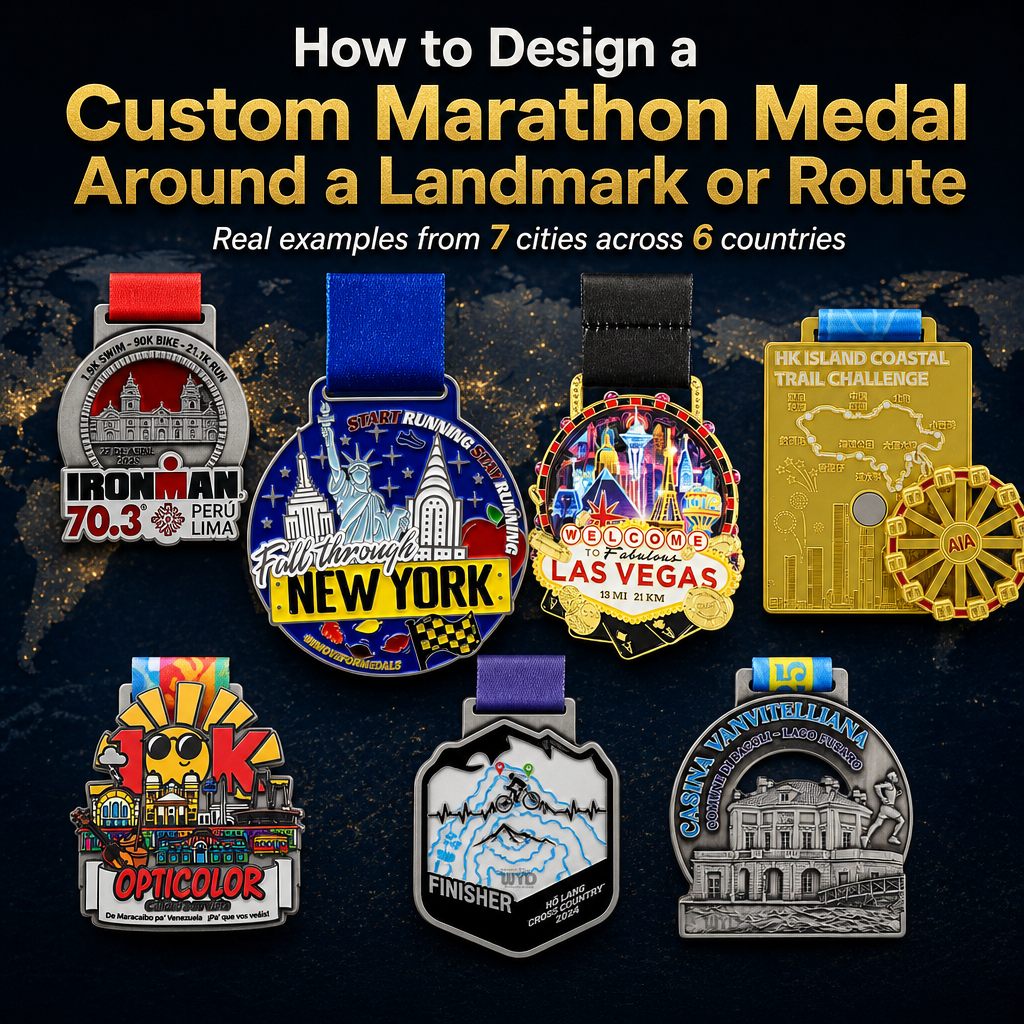
Why the Best Marathon Medals Are About a Place, Not Just a Race
A finisher medal is the most tangible evidence that a runner completed your event. For most participants, it will be displayed at home, worn in post-race photos, and shared on social media for years after the event itself is finished.
The question every race director should ask is: does this medal tell someone where this race happened?
Generic medals — a round disc with a running figure and the event name — answer that question with: not really. A runner who picks up such a medal five years later may need to read the text to remember which race it came from.
A landmark or route medal answers the question instantly. The shape of the medal, the image on its face, or the map engraved across its surface tells the story before a single word is read. A runner looks at it and immediately sees: this was the race that went past the cathedral on the lake. This was the night race through the neon city. This was the mountain trail with the heartbeat-line course map.
That recognition is what transforms a medal from a participation token into a genuine keepsake — and it is what drives participants to share it, wear it proudly and return to the event the following year.
The Two Main Approaches: Landmark and Route
Before choosing a design direction, it helps to understand the two primary strategies for location-based medal design.
Landmark-based design uses a specific architectural, cultural or geographic symbol from the event location as the central visual element. The landmark may be rendered as a detailed engraved relief, as a silhouette within a printed color background, or as the defining shape of the medal itself.
Route-based design uses the actual race course — its path, its terrain, its geography — as the primary visual element. The route may appear as an engraved line across the medal face, as a map outline showing checkpoints and location names, or as the die-cut shape of the medal's outer silhouette.
Many of the strongest designs combine both approaches: a landmark image placed within a route-shaped outline, or a city skyline beneath a course map. The examples below show how each strategy can be applied in practice.
Medal 1 — Maracaibo, Venezuela: A City Story on a Single Medal
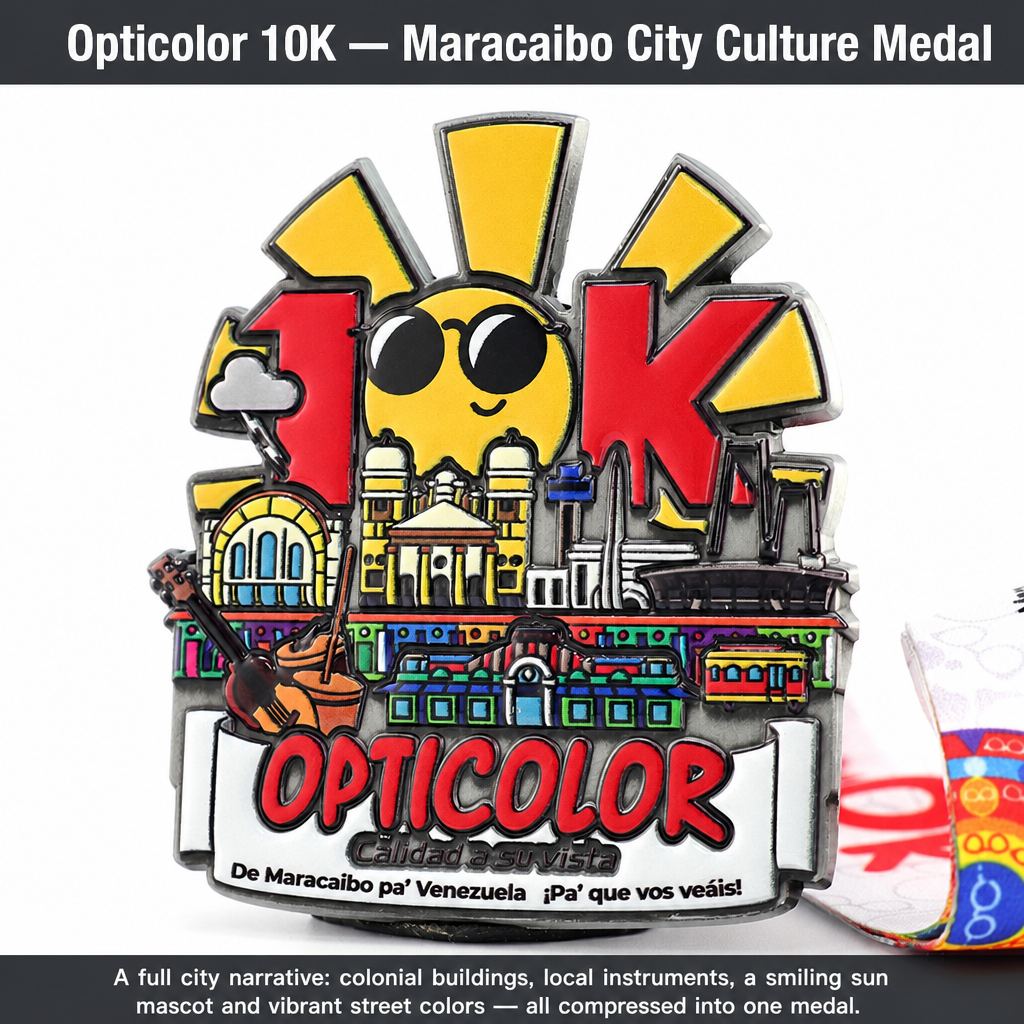
Opticolor 10K — Maracaibo City Culture Medal, Venezuela Image Caption: The Opticolor 10K medal from Maracaibo, Venezuela places a full city narrative on a single medal face: colonial-era buildings in bright local colors, a traditional cuatro guitar, a smiling sun mascot wearing sunglasses, and the Spanish text "De Maracaibo pa' Venezuela — ¡Pa' que vos veáis!" The colorful sublimation ribbon carries additional graphic elements from the event's visual identity.
This is one of the most complex approaches to city-based medal design: rather than selecting one landmark, the designer has included an entire cultural scene — architecture, music, local personality and civic pride — in a layered composition that reads as both a race award and a souvenir.
This approach works best when the event has a strong regional identity and wants the medal to appeal to both participants and non-participants as a collectible piece. The full-color UV printing is essential for achieving the depth and vibrancy of this type of composition.
Design takeaway: When your event represents a city with strong cultural identity, don't limit the design to one landmark. A scene composition — buildings, cultural symbols, local mascots and event distance — can create a medal that feels like a miniature city poster.
Design Strategy 1: The Architectural Relief
The most technically demanding approach to landmark medal design is the precision architectural relief — a detailed three-dimensional rendering of a specific building, rendered in die-cast metal with antique plating that brings out depth and shadow across every architectural element.
This technique is most effective for buildings with strong visual character: symmetrical facades, arched windows, ornate columns, historic towers, elaborate rooflines. The building is sculpted into the mold with sufficient relief depth that the architecture reads clearly in metal, rather than appearing flat or simplified.
The challenge is technical precision. Fine architectural detail — window grilles, decorative moldings, bridge railings, water reflections — requires careful translation from the original artwork to the 3D mold. A preview in the form of a 3D digital rendering should always be reviewed and approved by the event organizer before mold production begins.
Medal 2 — Bacoli, Italy: Building as Medal
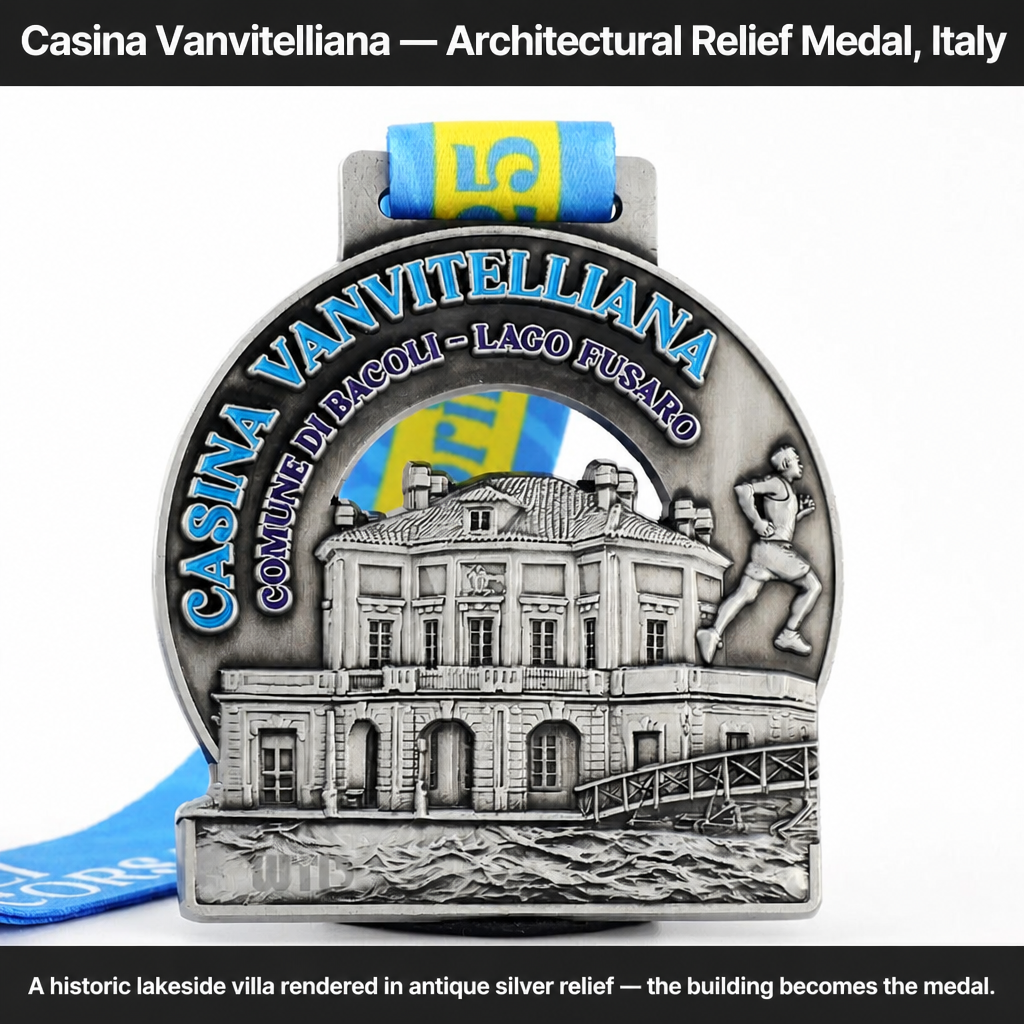
Casina Vanvitelliana — Architectural Relief Medal, Italy Image Caption: Produced for a 5K running event held at Lago Fusaro near Bacoli, Italy, this medal places the Casina Vanvitelliana — an 18th-century royal hunting lodge built on a small island in the lake — at the center of a semicircular die-cut design. The building is rendered in sub-millimeter antique silver relief, with the arched central frame creating a natural opening that allows the ribbon to be seen through the medal. A running figure appears at the right side of the arch. The blue and yellow sublimation ribbon carries the event name.
The architecture of the Casina Vanvitelliana has enough formal complexity — symmetrical wings, arcade ground floor, upper loggia, roof balustrade — to sustain a detailed metal relief that reads well both up close and at a distance. The semicircular frame turns the building's own facade into the medal's most prominent structural element.
Design takeaway: For races that pass through or finish at a historic landmark, a detailed architectural relief communicates that this specific place mattered to the event — not just generically, but in architectural detail. The building itself becomes the award.
Design Strategy 2: Combining Landmark with Triathlon or Multi-Sport Format
For multi-discipline events — triathlon, duathlon, swimrun, gravel race — the medal needs to communicate both the event format and the location. The most effective approach is to divide the design into distinct zones: one area dedicated to event identity (distances, disciplines, date) and another dedicated to the landmark that defines the course or finish line.
The two elements should be visually distinct but compositionally unified. A common method is to frame the landmark relief within a circular or rope-border medallion at the top of the design, while the event identity text appears on a separate plate at the bottom — creating a two-part medal that can be read at different scales.
Medal 3 — Lima, Peru: Landmark Meets Race Identity
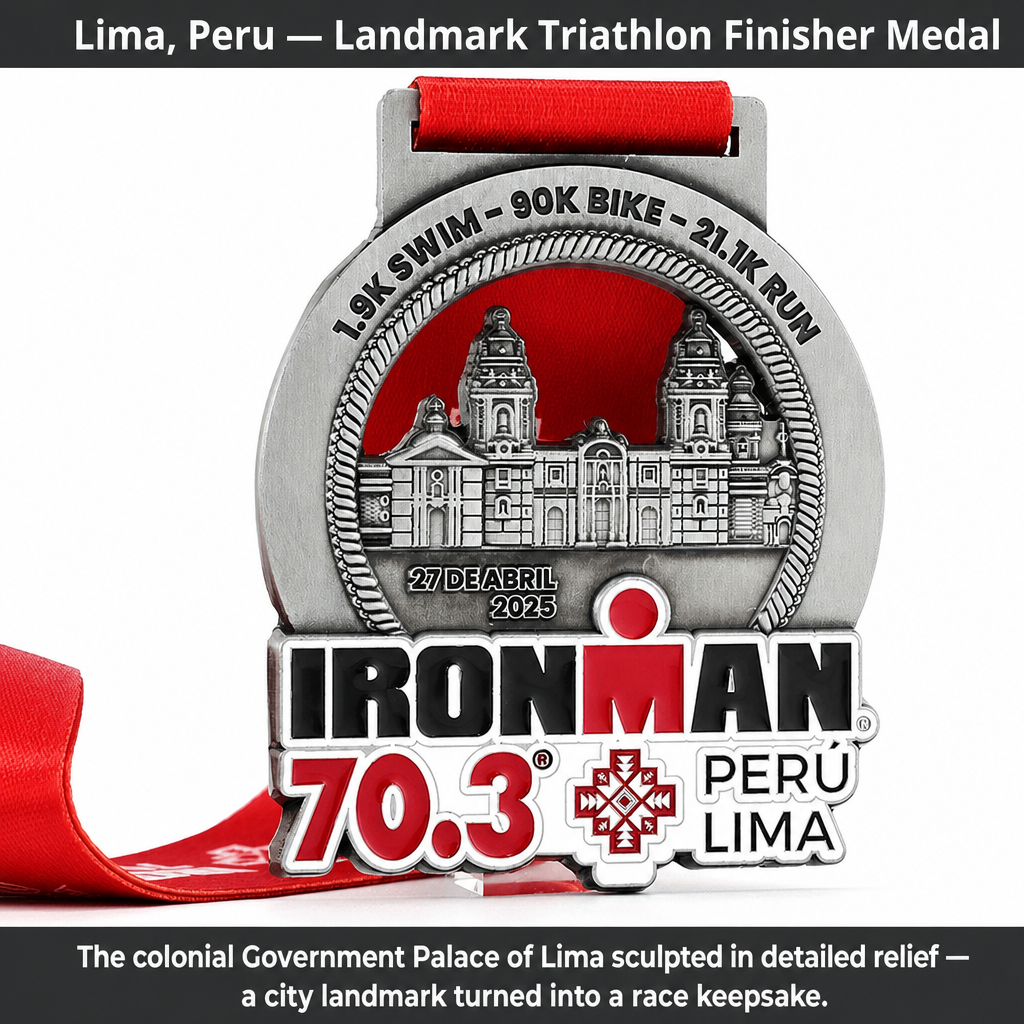
Lima, Peru — Landmark Triathlon Finisher Medal Image Caption: This triathlon finisher medal places the Government Palace of Lima — the historic Presidential Palace on the Plaza Mayor — in detailed antique silver relief within a circular rope-border medallion. The event distances (1.9K swim, 90K bike, 21.1K run), event date (27 de Abril 2025), and Peruvian national symbols appear in the surrounding and lower areas. The red satin ribbon carries the finisher's color.
The Government Palace of Lima is one of South America's most architecturally significant colonial buildings — its symmetrical towers, classical facade and the national coat of arms above the entrance are all recognizable from a distance. Placing it in antique silver relief on a circular medallion gives the finisher medal a weight and gravitas appropriate to the distance and difficulty of the event.
Design takeaway: For events set in cities with significant historic architecture, the landmark does not need to be the entire design — it can occupy the upper relief zone while the lower area carries the event's specific format and distance information. The result is a medal that identifies both the place and the achievement simultaneously.
Design Strategy 3: The Route Map as Medal Face
An alternative to landmark illustration is the direct visualization of the race route itself. Rather than depicting a building or city icon, the medal shows where the race actually went — the course drawn as a line across the medal face, with checkpoints, distance markers, location names and terrain elements placing the route in its geographic context.
Route map medals work best when the course has a distinctive shape — a loop with a recognizable outline, a point-to-point route across a geographic feature, or a trail that traces a river, coastline or mountain range. The map line should be engraved or printed clearly enough to be legible on the medal at normal viewing distance.
This approach is particularly effective for trail running, obstacle course events and city challenge races where the course itself is part of the event's identity and marketing.
Medal 4 — Hong Kong Island: Route Map with Spinning Landmark Charm
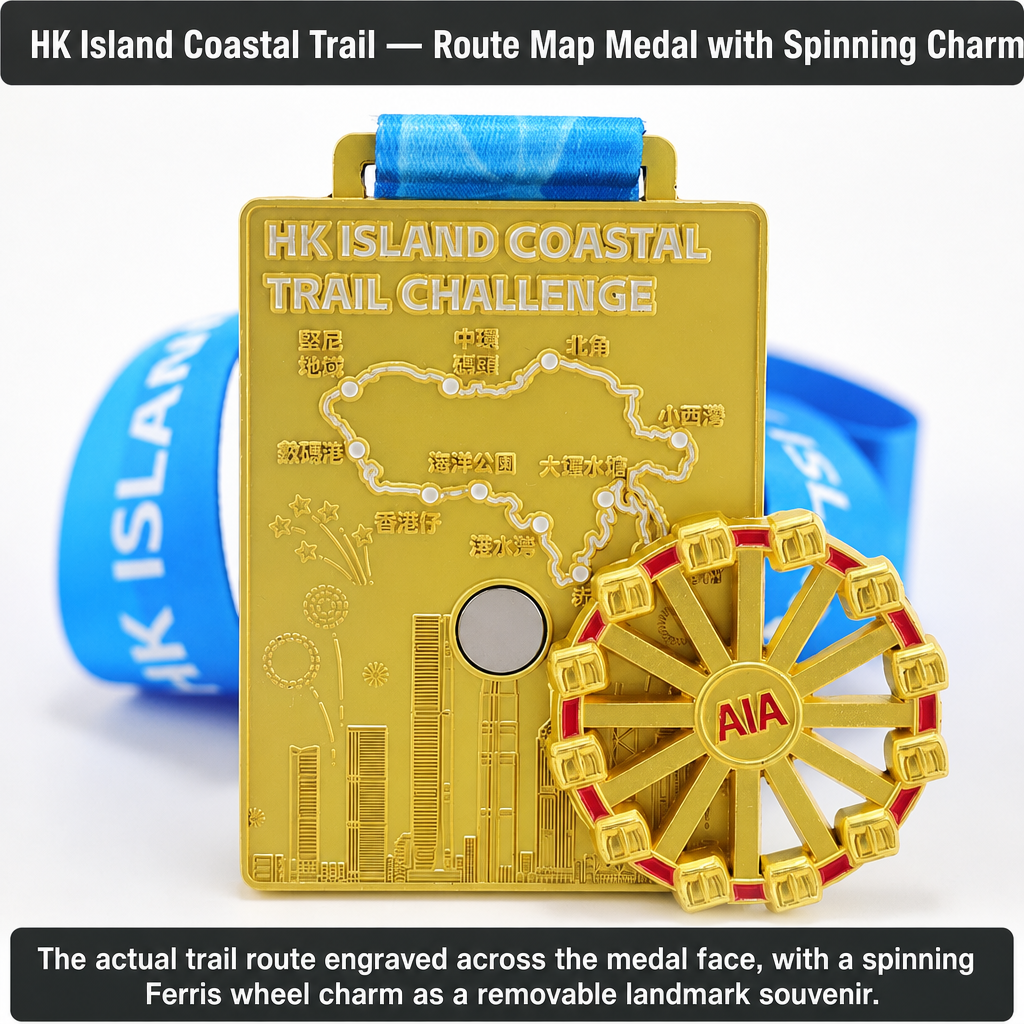
HK Island Coastal Trail Challenge — Route Map Medal with Spinning Ferris Wheel Charm Image Caption: The HK Island Coastal Trail Challenge medal combines two design strategies on a single award: the rectangular main medal body shows an engraved route map of the full course, with Chinese-language location names marking key checkpoints along the coastal path, and the Hong Kong city skyline engraved along the lower portion of the face. A spinning Ferris wheel charm — connected to the main medal by a magnet — serves as a removable landmark souvenir representing one of Hong Kong's most recognizable structures. The gold finish, sky-blue sublimation ribbon and AIA branding complete the design.
This medal demonstrates what is possible when route map design and landmark design are combined with an interactive physical element. The spinning wheel is not merely decorative — it can be detached and used as a standalone keepsake, turning the medal into two separate souvenirs from the same event.
Design takeaway: Route map medals can be elevated by adding a three-dimensional landmark element as a secondary charm or extension. The charm creates a physical connection between the abstract course map and the real location where the race was held.
Medal 5 — Hồ Làng, Vietnam: Terrain Becomes the Medal Shape
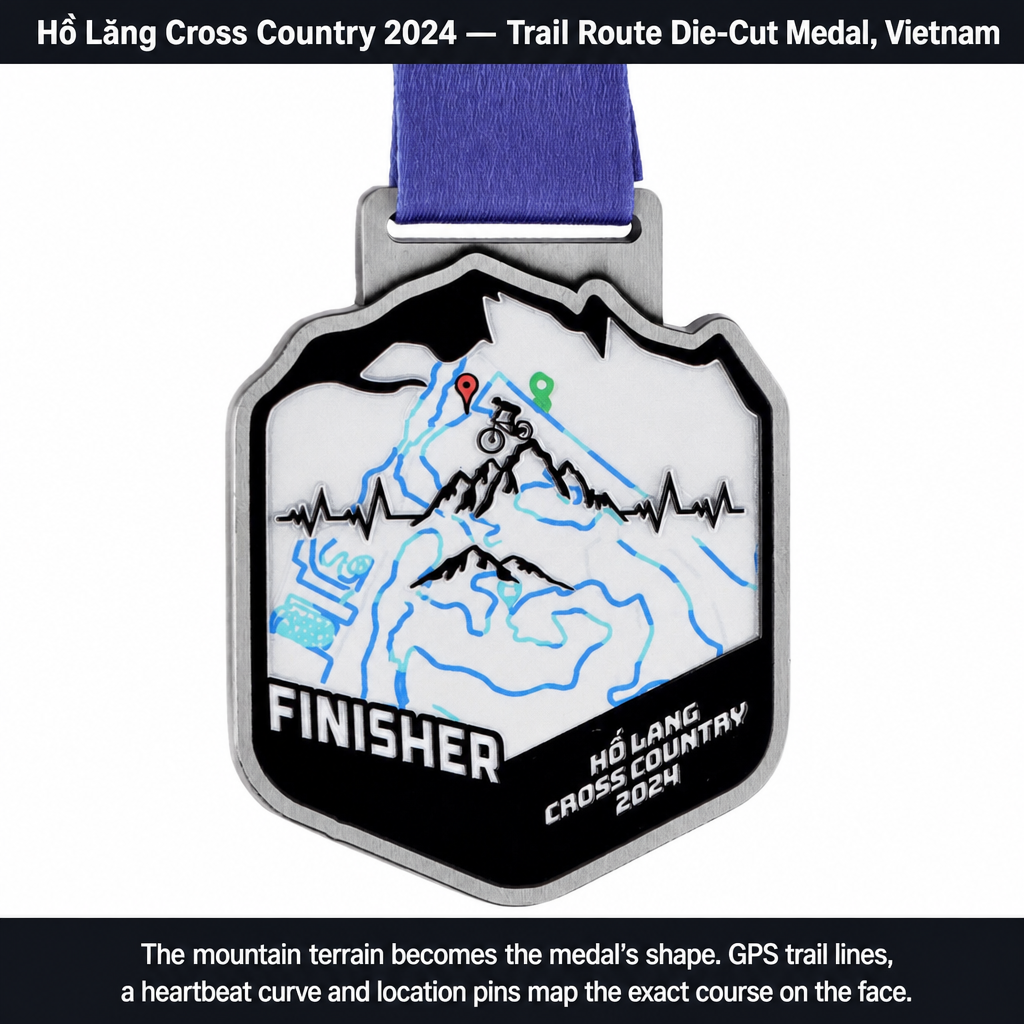
Hồ Làng Cross Country 2024 — Trail Route Die-Cut Medal, Vietnam Image Caption: The Hồ Làng Cross Country 2024 FINISHER medal takes the route-based approach to its logical conclusion: the medal's outer silhouette is cut to follow the outline of the mountain terrain itself. The mountain peaks visible on the course form the medal's top edge. Inside the die-cut body, the actual trail route appears as a blue line with GPS-style location pins marking the start and finish points, alongside a cyclist icon representing the cross-country format and a heartbeat ECG line suggesting the physical intensity of the race. A heritage site label identifies the course location.
The result is a medal that is immediately recognizable as a mountain race award — before any text is read, the shape alone communicates the terrain. The internal GPS map line and location pins then provide specific course information within that terrain-shaped frame.
Design takeaway: For mountain, trail and terrain-specific events, consider whether the medal's outer silhouette can reflect the landscape itself. A die-cut that follows the mountain ridge, river bend or coastal outline creates a medal that is visually unique to that specific race location and cannot be confused with a generic event award.
Design Strategy 4: City Icon and UV Full-Color Printing
Not every location has a single historic building that can sustain a detailed metal relief. Some cities are defined by a constellation of recognizable icons — a welcome sign, a famous street, a distinctive nighttime skyline, a cultural symbol that exists in collective memory rather than in any single structure.
For these locations, UV full-color printing offers a design approach that architectural relief cannot: the ability to reproduce an entire illustrated scene — gradients, lighting effects, neon colors, photographic detail — directly on the medal face. The metal body and border provide the structural and tactile premium quality of a die-cast award, while the printed surface carries the location's full visual identity.
This approach requires high-resolution source artwork and a clear understanding of how colors will appear on the metal surface under different lighting conditions.
Medal 6 — Las Vegas, USA: City Identity through UV Color
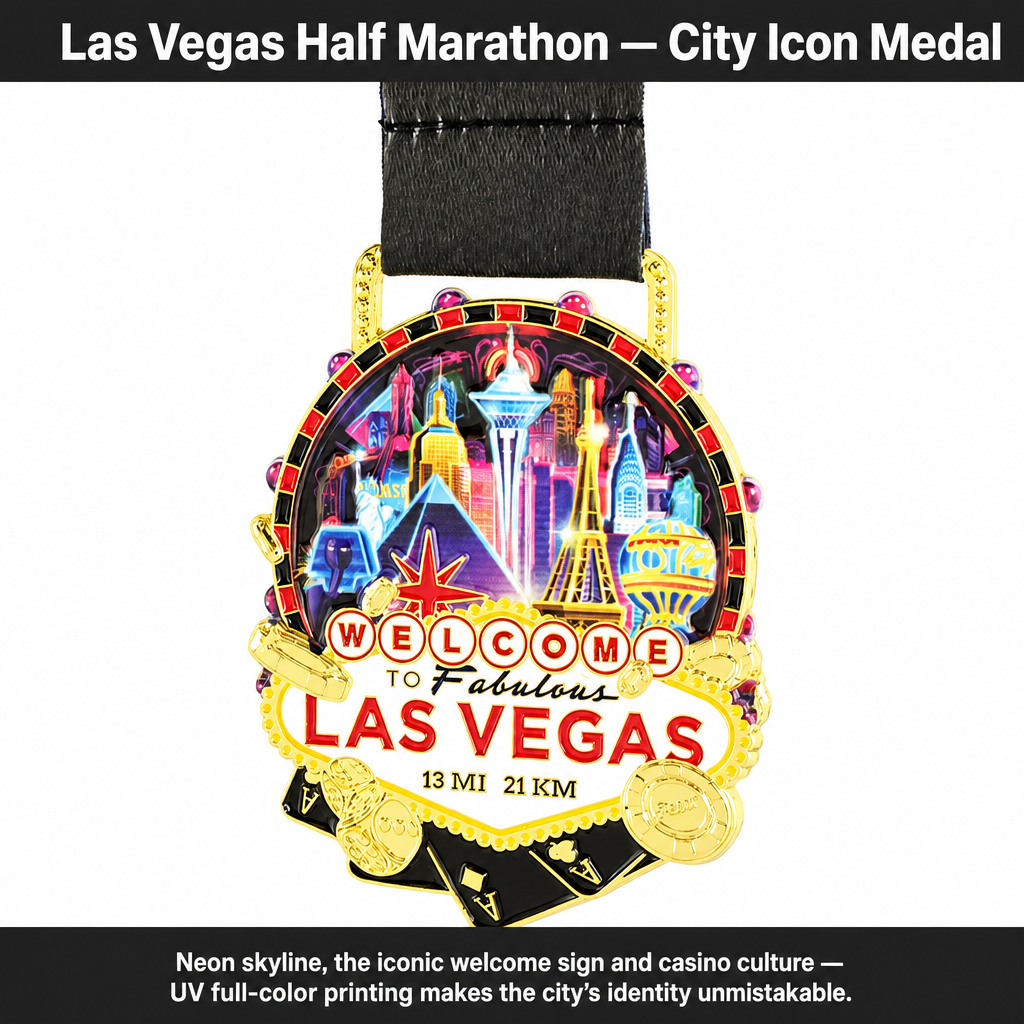
Las Vegas Half Marathon — City Icon Medal, USA Image Caption: The Las Vegas Half Marathon medal uses UV full-color printing to reproduce an illustrated neon cityscape across the medal's circular face — the iconic "Welcome to Fabulous Las Vegas" sign in the foreground, with stylized renderings of the city's most recognizable hotel and entertainment structures behind it. Casino-themed elements (playing card suits, poker chips) extend from the lower edges of the gold die-cast frame. Jewel-set gem accents in red and purple stud the circular border, adding a physical dimension that UV printing alone cannot provide. The 13 MI / 21 KM distance text appears prominently across the face.
Las Vegas is defined not by one building but by the collective visual language of the Strip — neon lights, entertainment architecture, the energy of the welcome sign. This medal captures that visual language through color illustration rather than structural relief, using the metal border and jewel accents to maintain the premium physical quality expected of a race finisher award.
Design takeaway: For cities with a strong visual identity based on color, lighting and multiple icons rather than a single landmark, full-color UV printing allows the medal to reproduce the city's entire visual character. The metal frame and physical elements (jewels, texture, plating) ensure the award still feels substantial and premium.
Medal 7 — New York, USA: Multi-Landmark Scene with Seasonal Context
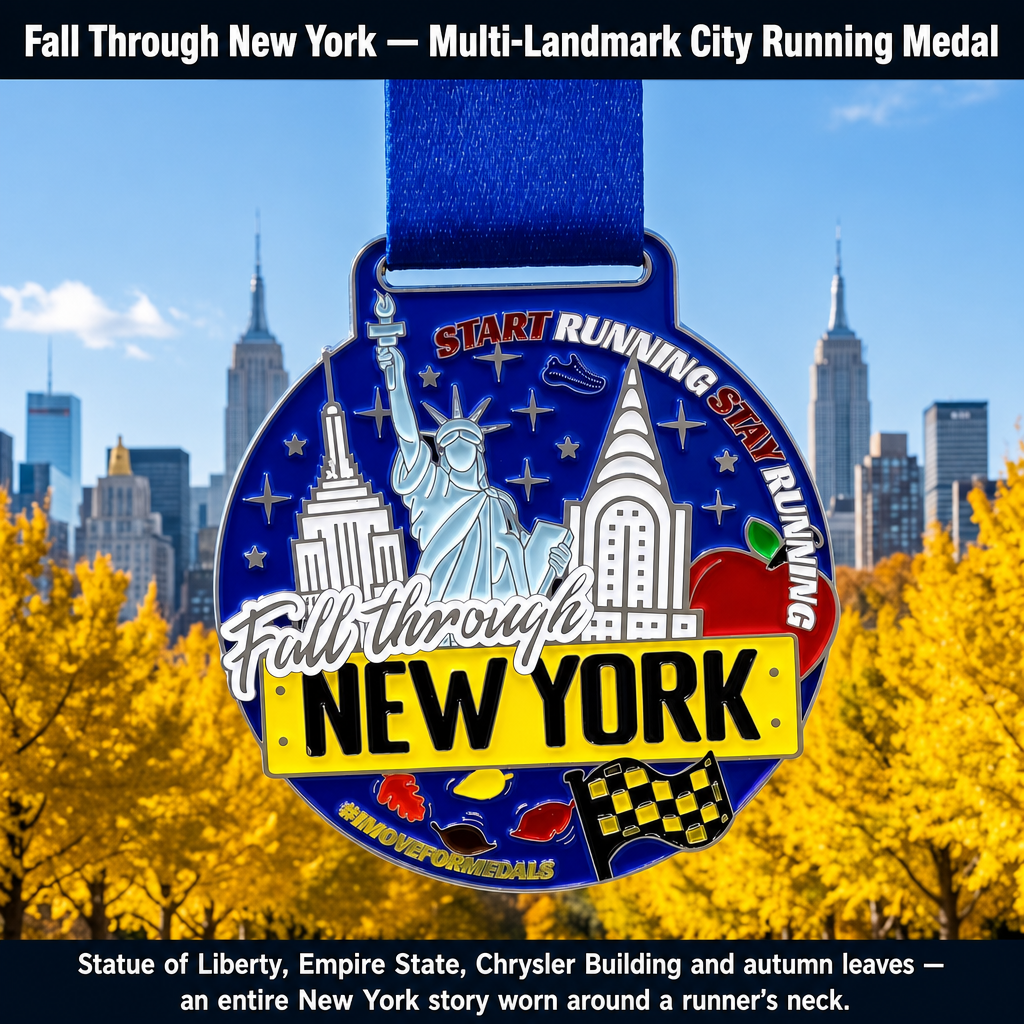
Fall Through New York — Multi-Landmark City Running Medal, USA Image Caption: The "Fall through New York" running medal combines multiple NYC landmarks — the Statue of Liberty, Empire State Building and Chrysler Building — in a single circular composition with a deep blue enamel background. Autumn leaves, a red apple and a checkered race flag introduce seasonal and finishing context. The event motto "START RUNNING STAY RUNNING" arcs along the upper edge. The real-world autumn park setting visible in the source photograph demonstrates how effectively the medal's colors and landmark composition translate to an outdoor finish-line environment.
This design shows how multi-landmark composition works when the city has several globally recognized symbols that, taken together, are more powerful than any one alone. The Statue of Liberty, Empire State Building and Chrysler Building form a skyline that is immediately recognizable worldwide. The seasonal additions — autumn leaves, the apple — anchor the medal to the specific time of year when the race takes place, adding a further layer of identity beyond location.
Design takeaway: For city races held at a specific season, the medal can combine landmark identity with seasonal context — not just where the race happened, but when. This creates a medal that commemorates the race as a specific moment in time and place, rather than a generic city event.
Key Design Decisions Before You Start
1. What defines your race location?
Is there one dominant landmark — a cathedral, a palace, a bridge, a mountain — that participants will immediately associate with the event? Or is the location defined by a combination of elements: a skyline, a culture, a color palette?
Single dominant landmark → consider architectural relief or die-cut silhouette. Multiple icons and cultural elements → consider UV full-color illustration.
2. Does your course have a distinctive shape?
Is the route a loop with a recognizable outline? Does it trace a coastline, a mountain ridge, a river? Could the course map be read as a design element on the medal face?
Recognizable course shape → consider route map engraving or terrain die-cut. Less distinctive course → focus on the location rather than the route.
3. What level of detail can the medal support?
Fine architectural detail, intricate map lines and small text all require sufficient relief depth and production precision. For very complex designs, a 3D digital rendering should be reviewed and approved before the mold is produced.
4. What is the right finishing technique for your design?
Antique silver or bronze plating works best for detailed architectural relief — the plating brings out depth and shadow in engraved surfaces. UV full-color printing works best for illustrated scenes, gradients and photographic-quality imagery. Combination approaches — relief metal with printed color fills — can achieve both.
5. Are there interactive or structural elements worth adding?
A spinning charm, a separate medallion, a magnetic attachment or a removable piece can transform a medal from a two-dimensional display item into a three-dimensional interactive souvenir. These elements add production complexity but create significant added value for the participant.
Working with a Factory on Landmark and Route Medal Design
Producing a medal based on a specific landmark or race route requires close collaboration between the event organizer and the manufacturer.
The process typically involves:
- Providing reference images and artwork for the landmark or route
- Reviewing a 2D design layout for dimensions, text placement and composition
- Reviewing a 3D digital model for relief depth and structural integrity
- Approving a physical or photographic sample before mass production
- Receiving progress updates through each production stage
At Zhongshan Wotid Hardware Co., Ltd., we work with race directors and event organizers worldwide to develop medals that reflect the specific identity of their event and location — from initial concept to on-time delivery before the race date.
Contact us with your event name, location, course details and approximate participant numbers. We will propose a design direction and quote within 24 hours.
Table of Contents
- Why the Best Marathon Medals Are About a Place, Not Just a Race
- The Two Main Approaches: Landmark and Route
- Medal 1 — Maracaibo, Venezuela: A City Story on a Single Medal
- Design Strategy 1: The Architectural Relief
- Medal 2 — Bacoli, Italy: Building as Medal
- Design Strategy 2: Combining Landmark with Triathlon or Multi-Sport Format
- Medal 3 — Lima, Peru: Landmark Meets Race Identity
- Design Strategy 3: The Route Map as Medal Face
- Medal 4 — Hong Kong Island: Route Map with Spinning Landmark Charm
- Medal 5 — Hồ Làng, Vietnam: Terrain Becomes the Medal Shape
- Design Strategy 4: City Icon and UV Full-Color Printing
- Medal 6 — Las Vegas, USA: City Identity through UV Color
- Medal 7 — New York, USA: Multi-Landmark Scene with Seasonal Context
- Key Design Decisions Before You Start
- Working with a Factory on Landmark and Route Medal Design