 EN
EN

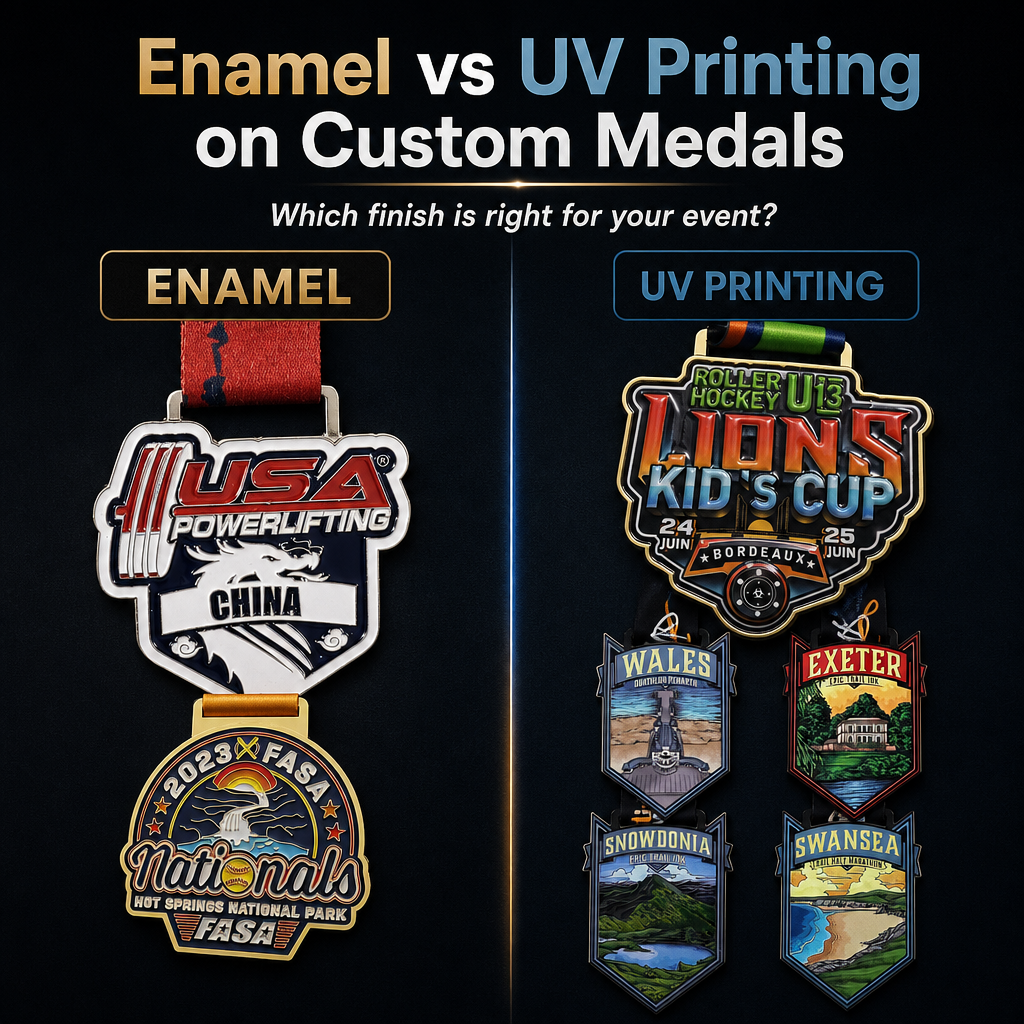
The Question Every Medal Organizer Faces
When you submit your artwork to a medal manufacturer, one of the first questions they will ask is: enamel or UV printing?
If you have never ordered a custom medal before, this question can feel technical and confusing. Both options can produce colorful, detailed, professional-looking medals. So what is actually different between them — and how do you know which one is right for your design?
The answer depends on three things: the complexity of your artwork, the type of colors you need, and what visual result you want the medal to deliver.
This article explains the real difference between enamel fill and UV printing on custom die-cast medals, with real examples of each technique so you can see — not just read — the distinction.
What Is Enamel Fill?
Enamel fill is the traditional method of adding color to a die-cast metal medal. After the medal is cast and plated, color is applied by hand or machine into the recessed areas of the medal face — the low points that sit below the surrounding raised metal borders.
The key feature of enamel fill is the raised metal border between color areas. Because the color sits inside a recessed zone surrounded by the plated metal surface, each color block is physically separated from the next by a visible metal line. This gives enamel medals a structured, segmented appearance — similar to stained glass, where the lead lines between colors are part of the visual design.
Enamel color is applied as a liquid resin or paste, then cured to a hard, smooth finish. The result is a surface that is durable, scratch-resistant and consistent across large production runs.
Enamel Medal Example 1 — USA Powerlifting China
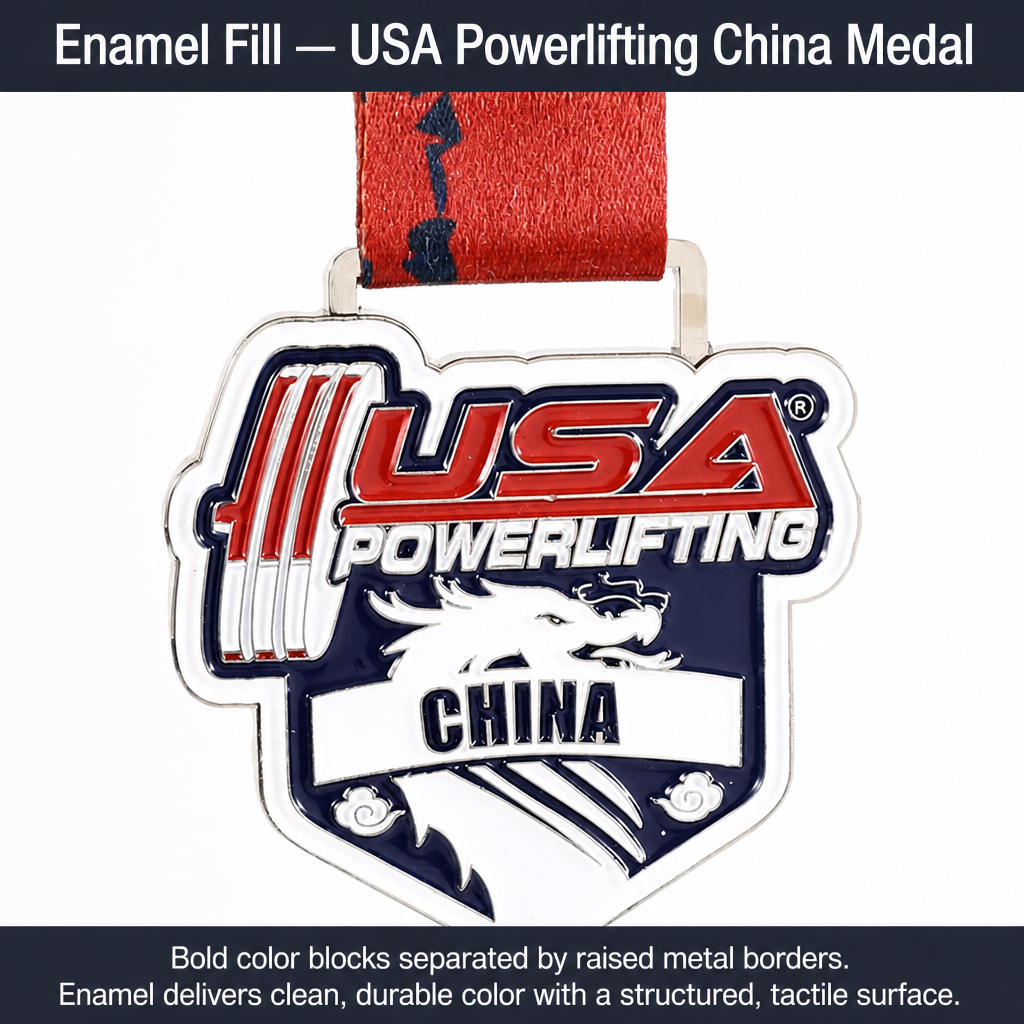
Enamel Fill — USA Powerlifting China Medal Image Caption: The USA Powerlifting China medal uses three bold enamel color blocks — red, navy and white — separated by clearly visible raised silver metal borders. The dragon motif in the lower section and the "CHINA" banner are rendered in white enamel against a navy background. The raised red "USA POWERLIFTING" lettering sits above the enamel surface, giving the design strong physical depth and contrast.
This medal demonstrates the fundamental characteristic of enamel fill: each color occupies a defined, bordered zone. The red, navy and white areas are visually clean and precise because the metal borders prevent any overlap or bleeding between colors. The result is bold, high-contrast and immediately legible — even from a distance.
When enamel works best: Designs with a limited number of solid colors, clear color boundaries, logo-style artwork, flag colors, and bold text are ideal candidates for enamel fill. The metal borders become part of the design rather than a limitation.
Enamel Medal Example 2 — FASA Nationals Softball
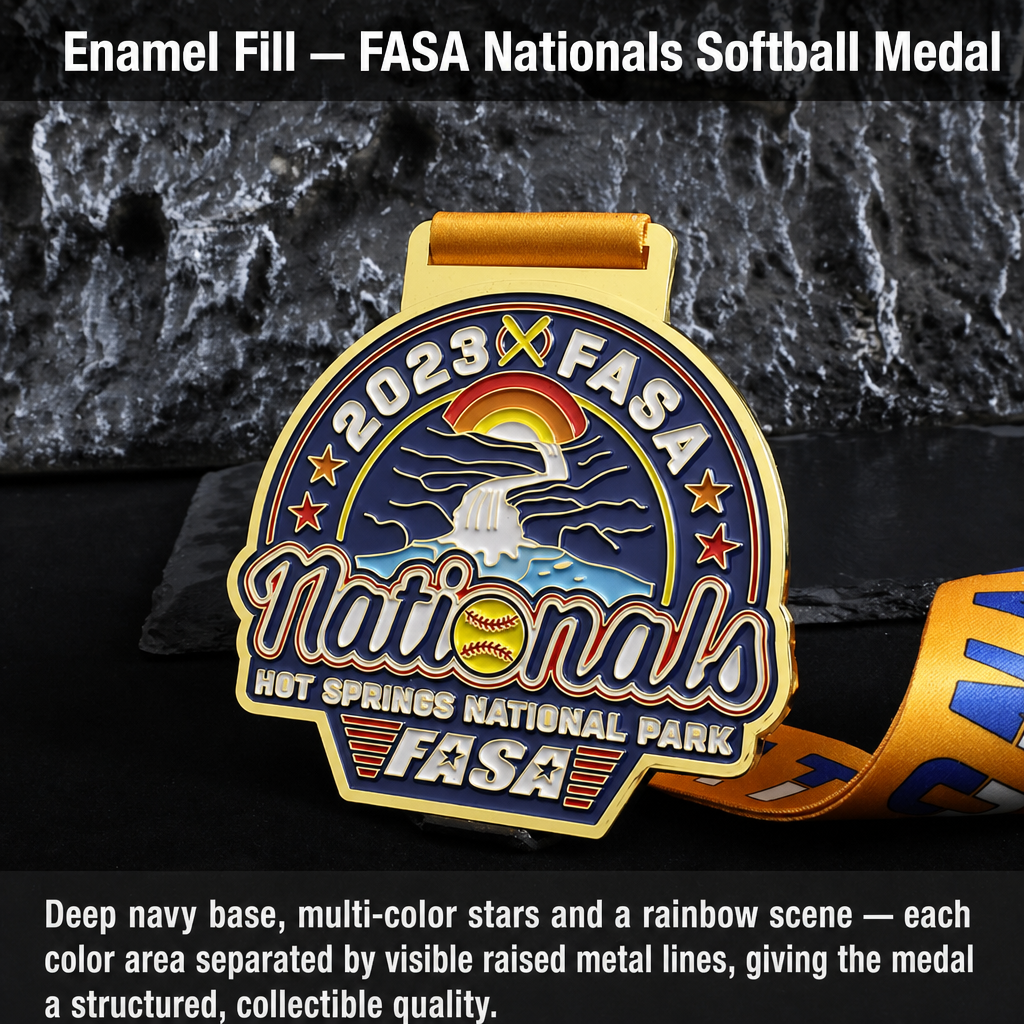
Enamel Fill — FASA Nationals Softball Medal, Hot Springs National Park Image Caption: The 2023 FASA Nationals medal uses a deep navy enamel base with multiple color areas: a rainbow arc, a waterfall scene, red and gold stars, a yellow softball, and the "Nationals" script in white. Each color element is separated by raised gold metal borders. Despite the number of colors, the design remains clean because the metal partitions keep every element in its own zone.
This medal shows that enamel fill can handle more complex compositions — not just two or three colors, but multi-element scenes — as long as each color area has a clear boundary defined by the raised metal structure. The result still reads as enamel: structured, segmented, with the metal border lines visible as part of the design.
What this medal confirms: Enamel fill can support scene-based designs with multiple color elements, but each element needs to be a defined block rather than a gradient or blended transition.
What Is UV Printing?
UV printing is a different approach entirely. Instead of applying color into recessed zones separated by metal borders, UV printing uses a high-precision inkjet process to print a full-color digital image directly onto the medal surface.
The image is applied as a flat layer and then cured instantly using ultraviolet light, bonding the ink to the metal or epoxy-coated surface. The result is a smooth, flat color area with no raised metal borders between colors — the image looks and behaves more like a printed photograph or illustration than a traditional enamel fill.
UV printing can reproduce virtually any artwork: gradients, shadows, skin tones, photographic landscapes, cartoon characters with shading, neon effects, complex lettering with multiple colors within a single word, and scenes with dozens of color transitions across a small area.
The trade-off is surface texture. UV printing produces a flat, smooth printed surface rather than the recessed-and-raised tactile quality of enamel fill. For designs that rely on visual complexity rather than physical depth, this is usually the right choice.
UV Printing Example 1 — Lions Kid's Cup Roller Hockey
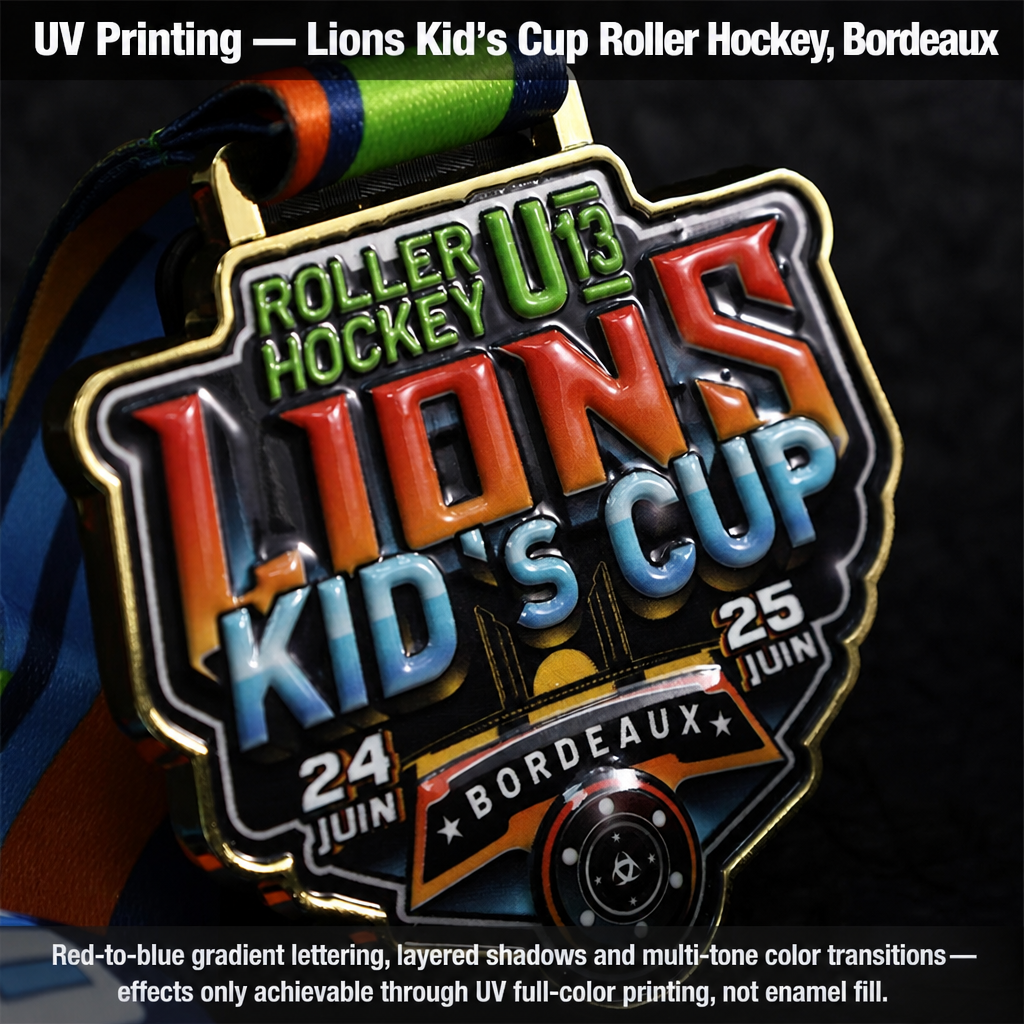
UV Printing — Lions Kid's Cup Roller Hockey, Bordeaux Image Caption: The Lions Kid's Cup medal uses UV printing to achieve multi-color gradient lettering — "LIONS" transitions from red through orange to blue across a single word, and "KID'S CUP" follows a similar gradient arc. The layered shadow effects beneath the lettering, the subtle texture of the dark background, and the fine detail on the roller hockey puck charm are all produced through UV printing. No enamel fill could replicate these color transitions within a single text element.
This medal illustrates the defining advantage of UV printing: the ability to transition colors continuously within a single design element. The gradient across "LIONS" goes through four or five distinct tones in the space of a few centimeters. In enamel, each color would require a separate bordered zone — making this type of lettering effectively impossible with traditional fill techniques.
When UV printing works best: Designs with gradient color transitions, multi-color text, layered shadow effects, or fine color detail within small areas are candidates for UV printing rather than enamel.
UV Printing Example 2 — Cartoon Character Fun Run Medals
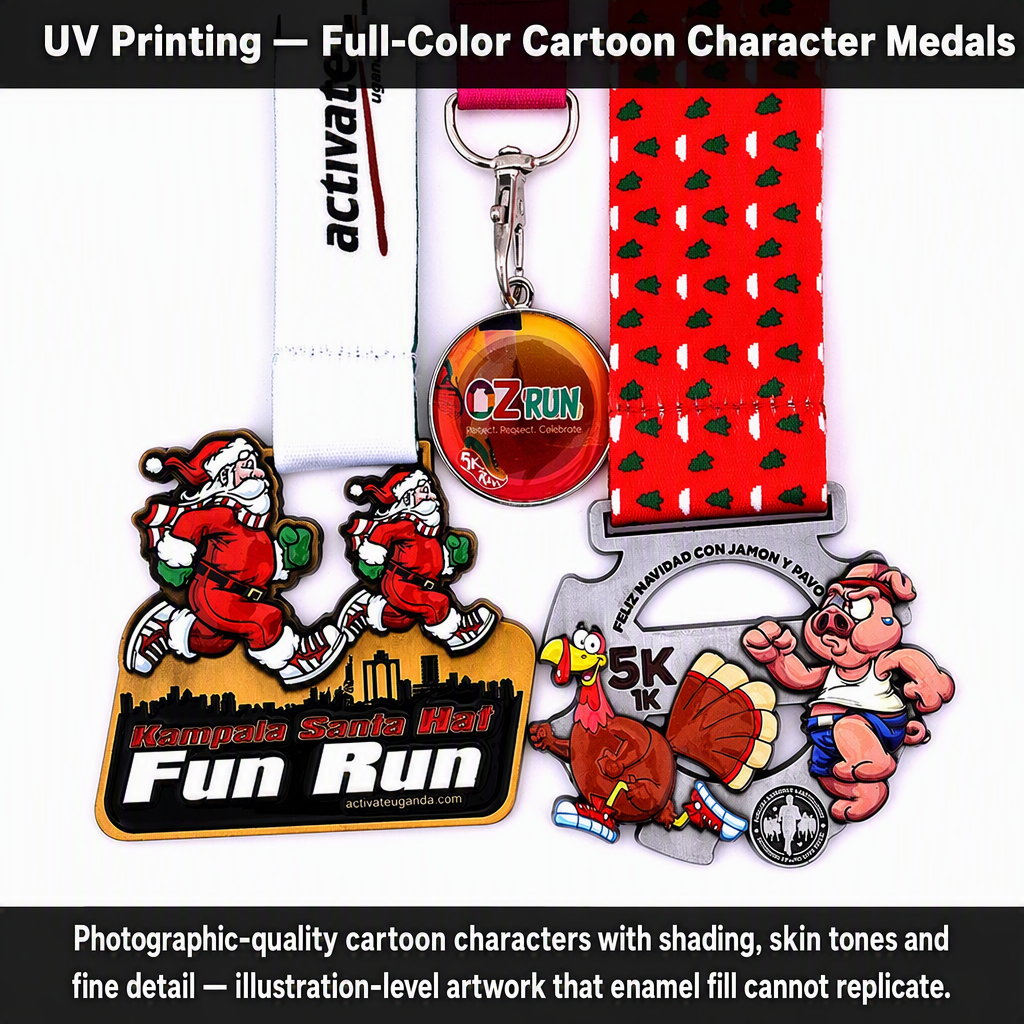
UV Printing — Full-Color Cartoon Character Medals (Santa Hat Fun Run, OZ Run, 5K 1K) Image Caption: Three UV-printed medals demonstrating the technique's ability to reproduce full-color cartoon character artwork with photographic detail: the Kampala Santa Hat Fun Run medal features two running Santa Claus figures with facial expressions, clothing folds, shadows and skin tones; the OZ Run circular charm reproduces a detailed event logo with photographic color fidelity; the 5K 1K medal shows a cartoon turkey and pig in mid-action, with full character shading, body proportion and color depth. None of this detail could be achieved through enamel fill.
Character-based medal artwork requires the kind of color rendering that printing excels at: skin tones, fabric shading, facial expressions, dynamic action poses with motion-implied lighting, and backgrounds that contextualise the characters within a scene. Enamel fill works with flat color zones — it cannot produce the subtle tonal variations that make a cartoon character feel three-dimensional and expressive.
What this confirms: For event medals featuring mascots, cartoon characters, illustrated portraits or any artwork that relies on shading and tonal variation, UV printing is the only practical technique.
UV Printing Example 3 — UK Trail Series: Wales, Exeter, Snowdonia & Swansea
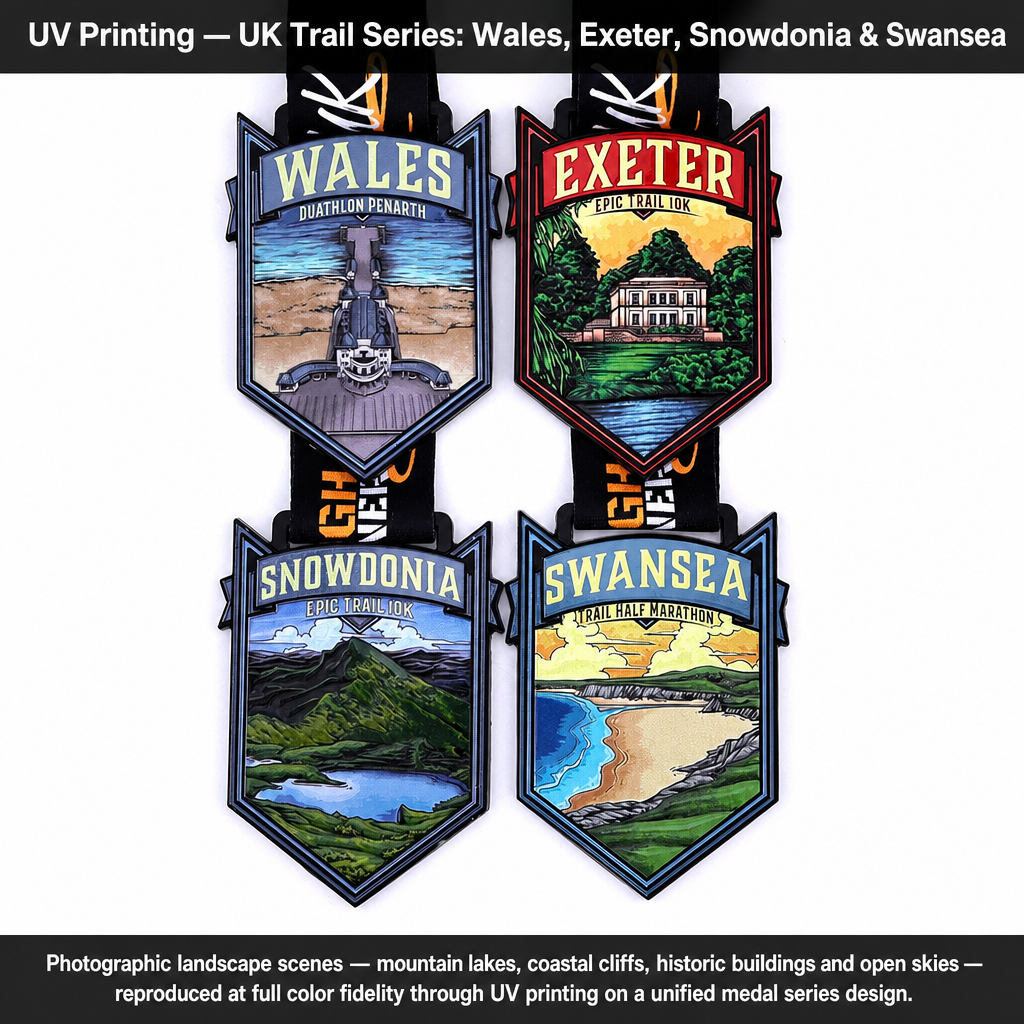
UV Printing — UK Trail Series: Wales Duathlon, Exeter Epic Trail, Snowdonia Epic Trail & Swansea Trail Half Marathon Image Caption: Four medals from a UK trail running series, each featuring a full-color landscape scene specific to the event location: a helicopter landing zone in the Welsh hills (Wales Duathlon Penarth), a Georgian country house surrounded by trees (Exeter Epic Trail 10K), a mountain lake in Snowdonia (Snowdonia Epic Trail 10K), and a coastal bay with chalk cliffs (Swansea Trail Half Marathon). Each scene is reproduced at photographic color fidelity — cloud gradients, water reflections, green hillside tones, and sunlit architectural detail — within a unified die-cut medal design that changes only the scene and event name across the series.
This is the most powerful use case for UV printing in event medal design: a series of events that share a design format but require a different location-specific scene for each medal. The same medal shape, border and text structure is used across all four events. Only the landscape artwork changes. This allows the event series to maintain a unified visual identity while giving each individual event a completely unique, location-specific medal.
Reproducing these landscapes in enamel would require a different mold for each scene — because the scene outlines would need to be physically cast into the metal. UV printing applies the scene as a flat image, requiring only one mold for the shared die-cut format.
What this confirms: For event series, multi-location races, and any design requiring photographic landscape reproduction, UV printing enables a level of visual specificity that enamel fill cannot match.
Side-by-Side: The Key Differences
Table of Contents
- The Question Every Medal Organizer Faces
- What Is Enamel Fill?
- Enamel Medal Example 1 — USA Powerlifting China
- Enamel Medal Example 2 — FASA Nationals Softball
- What Is UV Printing?
- UV Printing Example 1 — Lions Kid's Cup Roller Hockey
- UV Printing Example 2 — Cartoon Character Fun Run Medals
- UV Printing Example 3 — UK Trail Series: Wales, Exeter, Snowdonia & Swansea
- Side-by-Side: The Key Differences
- How to Decide Which Technique Is Right for Your Design
- Final Thought